
Weeds specialist battles infestations and fosters consensus
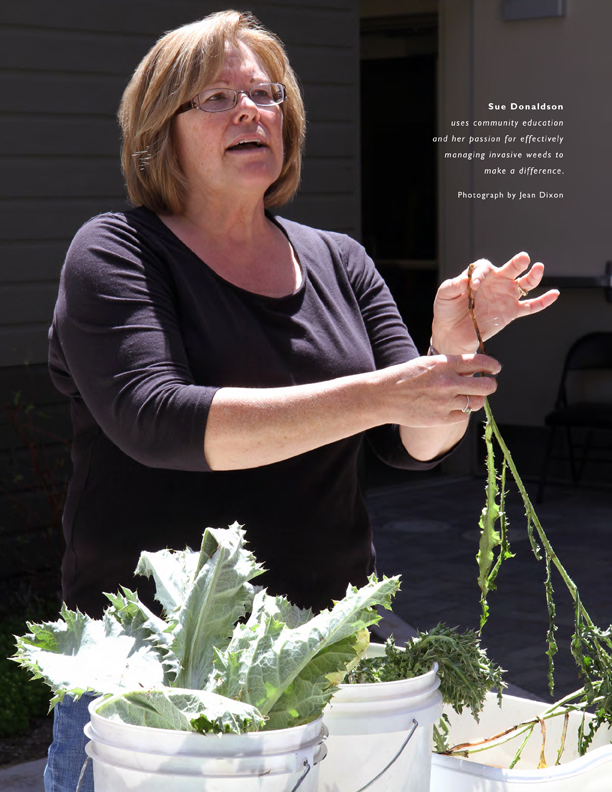
Sue Donaldson uses community education and her passion for effectively managing invasive weeds to make a difference. Photo by Jean Dixon.
Sue Donaldson, University of Nevada Cooperative Extension (UNCE) water quality education and weeds specialist, has had a blooming career killing weeds in the Tahoe Basin. As the founding chair of the Lake Tahoe Basin Invasive Weed Coordinating Group, Donaldson has worked both behind the scenes gaining consensus among agencies and landowners and within the community. Her passion for community outreach is as evident as her desire to keep Lake Tahoe pristine.
Donaldson started at the UNCE as a water quality program coordinator in 1994 and soon began working with invasive weeds in the Tahoe Basin. Her foray into the world of weeds at Lake Tahoe began when she found perennial pepperweed, known colloquially as tall whitetop, growing at an elevation not thought possible.
“After the flood in 1997, I had been drawn into working on invasive weeds because the flood moved around a lot of plants,” Donaldson said. “I still remember the day in 1998 when I was driving up to our office in Incline Village and I saw a perennial pepperweed plant. All of the characteristics of the plant led me to believe it could be a problem for Lake Tahoe.”
The plant’s rapid growth and its friable root system allow erosion around waterways. Because Lake Tahoe’s water quality is an important issue for agencies and organizations in the basin, Donaldson took responsibility for controlling the plants. She set to work on bringing together all relevant agencies and land managers to find the best way to eliminate the plant while remaining within the Lahontan Regional Water Quality Control Board’s stringent water quality standards.
“The only effective way to control this plant currently is to use a herbicide,” Donaldson said. “But no one would even consider using herbicides because they were afraid of violating the standard. So we reached a consensus and we had the Lahontan Regional Water Quality Control Board participate in the process. It was the first time any group, since I started working in Cooperative Extension, had agreed on the need to control an invasive weed using a herbicide where everyone was comfortable with what was being done.”
From that project sprang the Lake Tahoe Basin Invasive Weed Coordinating Group in 2001, an organization comprised of agencies and community members invested in gathering information and controlling invasive weeds in the Tahoe Basin. It’s been nearly a decade since Donaldson helped to spearhead the group and she continues to work closely with them.
“We wanted to work together to find and effectively manage invasive weeds using our individual resources,” Donaldson said. “We went from ‘how are we going to have a group at all’ to this highly functional group that now has done annual basin wide sweeps to find and document invasive weeds. I wrote a formal proposal in 2003 to the Lahontan Regional Water Quality Control Board to allow the group to use herbicides under specific circumstances. We came up with a protocol that allows us to use one of three herbicides on certain perennial invasive or noxious weeds so that we can treat the weeds quickly before they can spread.”
Though Donaldson has her hands immersed in water quality and invasive weeds, she never strays too far from community education and involvement. She continues to work with the Lake Tahoe community on invasive weeds education, conducting annual training, public events and publishing resource materials.
“I really developed a passion for doing community education where I could see concrete outcomes in terms of improving our water resources,” Donaldson said. “I also really like being able to work one-on-one with people, learning from people and helping them with their issues. It’s been a rewarding experience working at Lake Tahoe, especially because I get to work with devoted people who want to make a difference.”
 Guia Marie Del Prado