
Emerging technology shakes up Lake Tahoe earthquake studies
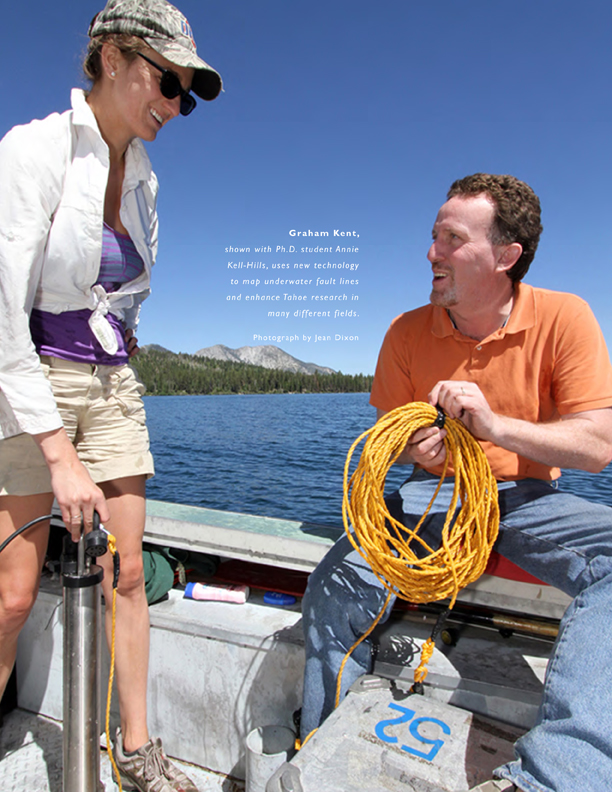
Graham Kent, shown with Ph.D. student Annie Kell-Hills, uses new technology to map underwater fault lines and enhance Tahoe research in many different fields. Photo by Jean Dixon.
Under Lake Tahoe’s serene surface lie three major fault lines capable of up to magnitude 7.3 earthquakes, which can create 10 meter high tsunami waves. Graham Kent, Nevada Seismological Laboratory Director and geological sciences and engineering professor hopes to learn more about the basin’s seismological activity and lend aid to other research programs taking place at Lake Tahoe using emerging technologies.
Using the seismic CHIRP profiler developed by Kent’s colleague Neal Driscoll from the Scripps Institution of Oceanography, he and his team were able to map the lakebed’s rock layers and the basin’s three major faults: the West Tahoe Fault, the North Tahoe Stateline Fault and the Incline Village Fault. The mapping of the underwater fault lines is part of underwater paleoseismology, an emerging science within seismology.
“A lot of important fault systems in the world are underwater,” he said. “This very high-resolution technique allows us to mimic underwater what paleoseismologists do on land. There are important fault systems all around us that need this type of approach and we learned to do it in Tahoe first. Tahoe has been the experimental test bed for this technique.”
With the seismic CHIRP profiler, Kent can analyze the fault systems in detail. Since developing the first images of the faults in 1999, he and his team were able to determine the faults’ cycles and magnitudes. Though events like 7.3 magnitude earthquakes or 30 feet high tsunamis swallowing whole beaches and buildings are possible, the chances of an event in the near future are small.
“It’s a bit like winning the ‘geolottery,’ ” Kent said. “You’d have to be pretty unlucky. But if you’re a government official, you have to plan, you have to know that this could happen.”
Kent also hopes to improve the daily monitoring of seismic activity and potential forest fires by installing cameras at specific locations around the basin; Forest Guard is a collaborative project with Sony Europe and a group of Californian students who devised the social networking aspect to the system.
“We’re hoping in the next several years to build a more reliable digital network,” he said. “We’re excited about that aspect of getting a better seismic network and putting more eyes on Tahoe 24/7.”
Kent and his team are also applying the seismic CHIRP profiling, side-scan sonar and a multibeam system to other interdisciplinary projects including invasive species studies on clams and climate and drought research in Fallen Leaf Lake. Kent believes using new technology to conduct research across different and interconnected fields can change people’s perceptions about Lake Tahoe’s environment.
“There’s an opportunity to use new technologies to learn more about the lake’s history,” Kent said. “To foretell the future or to give people a better appreciation for the Lake Tahoe they don’t know. There are larger forces with earthquakes and extended droughts, which is not something many experience in their lives, but may have a profound effect on Tahoe’s environment when they occur.”
Kent, a native of Lake Tahoe, first became interested in geology as a rock climber in the Lake Tahoe Basin. After working at the Woods Hole Oceanographic Institution and the Scripps Institution of Oceanography, he returned to his hometown to contribute to the seismological and overall body of research being done in the basin.
“I hope people appreciate that we are ushering in a new high-tech era for Lake Tahoe science to not only address seismic hazards but a myriad of issues,” Kent said. “Most people don’t have access to the tools that are needed to take Tahoe research to the next level and we’ve been doing bits and pieces for the last 10 years. Technology is a large factor, not only to enhance Tahoe research but also understanding the whole Sierra Nevada microplate tectonics. I am also excited to have the opportunity to have an impact on the place where I grew up.”
 Guia Marie Del Prado