
Peering into Lake Tahoe’s past droughts using tree rings
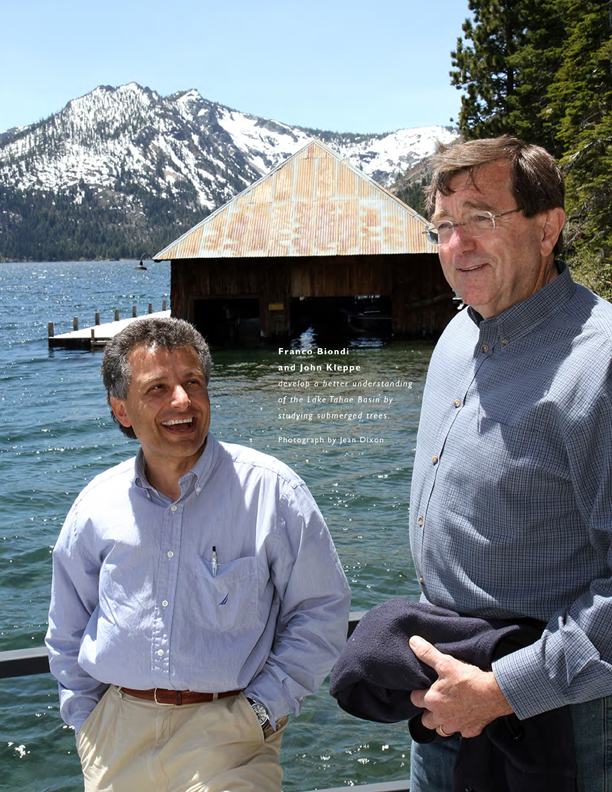
Franco Biondi and John Kleppe develop a better understanding of the Lake Tahoe Basin by studying submerged trees. Photo by Jean Dixon.
The Lake Tahoe Basin’s history has a way of leaving clues behind, even as its environments change, its shores shift, and its inhabitants change. Franco Biondi, ecoclimatologist, geography associate professor and DendroLab Director, analyzes the evidence left by tree rings to better understand the Tahoe Basin’s past and present and to better prepare for its future.
Biondi’s interest in dendrochronology, the field of dating tree rings, was first sparked as an undergraduate at the Università di Firenze, Italy, when he was commissioned with dating wood beams in an old section of Siena using dendrochronology. Intrigued with the science, Biondi continued his studies at the University of Arizona’s renowned Laboratory of Tree-Ring Research. He accepted a faculty position at the University of Nevada, Reno in 2000. Since then he developed the DendroLab and has been involved in a number of interdisciplinary programs.
Biondi’s work in the Tahoe region began in 2003 when electrical engineering professor John Kleppe approached him about dating the rings of submerged rooted trees in Fallen Leaf Lake. Kleppe discovered the trees while fishing and began documenting them using a remotely operated vehicle of his own design. After engaging divers to retrieve samples, he found that they were fairly well preserved.
“He wanted to know the date of these samples,” Biondi said. “We went around this lake in the Desolation Wilderness and collected a number of tree-ring samples. We developed a chronology that goes back to A.D. 543 and dated one of his samples to the years A.D. 1085 to 1153.”
Biondi, Kleppe and their fellow collaborators found evidence of a 200-year long drought, which changed Fallen Leaf Lake’s water levels and allowed the trees to grow 30 to 40 meters below its present shoreline.
“The precipitation averaged 60 percent of normal,” he said. “At the end of the drought, the trees were submerged so quickly that they didn’t have time to decompose. One of the submerged trees is at least 221 years old, so the lower lake levels allowed the trees to grow for 200 years or more.”
Combining studies done by other researchers, including Nevada Seismological Lab Director Graham Kent’s map of ancient shorelines, they concluded that the causes of the drought were climatic. If such an event occurred in the near future, the effects on the local communities, economies and environments would be devastating.
“The Lake Tahoe Basin is a unique ecosystem with an interesting past,” Biondi said. “If there is a possibility of such an extended drought reoccurring, it is important that we understand what kind of plans would be needed to ensure that we lived through it.”
Though the group is currently publishing their findings, Biondi hopes to extend the study to other lakes in the basin. He also hopes to accumulate more samples from submerged trees in other Sierra Nevada lakes, just as researchers are doing in the European Alps. Biondi and Kleppe believe that collaboration among different fields is crucial.
“You need each one of our fields to bring this all together,” Kleppe said. “I don’t think you’re going to really understand climate change until you do. Fallen Leaf Lake may have one of the best records of climate change through the Holocene period.”
Biondi continues to combine dendrochronology with other fields, under the umbrella of ecoclimatology, a science aimed at understanding the interaction between climate and ecosystems.
“Ecosystems are constantly changing,” he said. “Knowing why they change is important because then you are better able to prepare for the future. What’s nice about trees is their growth can be dated and used as markers in time for the environmental changes that happened around them.”
 Guia Marie Del Prado