
Integrating the forest into Lake Tahoe’s conservation management
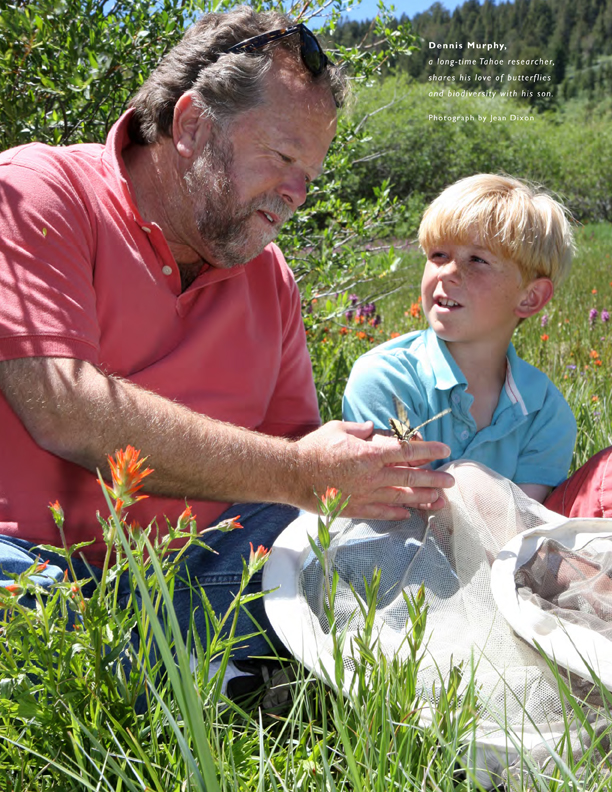
Dennis Murphy shares his love of butterflies and biodiversity with his son. Photograph by Jean Dixon
Dennis Murphy, a conservation biologist at the University of Nevada, Reno, was first acquainted with the Lake Tahoe Basin as a child on family outings to his grandfather’s cabin at Echo Lake. He owes his respect for nature to his time spent at that high mountain cabin.
“I’ve always loved Lake Tahoe and appreciated its unique physical setting and biological richness,” Murphy said. “It was my time in the Lake Tahoe Basin that was my stimulus for becoming a biologist. I collected butterflies like most kids might do for a few months, but I never actually stopped.”
Now Murphy has combined his love for the Lake Tahoe Basin and his expertise in conservation biology to shed light on the functions of terrestrial ecosystems’ in Lake Tahoe’s entire watershed.
Murphy’s more recent intensive work at Lake Tahoe began in 1997 as the lead editor, alongside Chris Knopp, of the Lake Tahoe Watershed Assessment, which documents research materials relevant to land management and restoration practices in the basin. Funded by the United States Forest Service, the two volumes contained a synthesis of almost 20 scientists’ work on Lake Tahoe’s water and air quality, biological diversity and socioeconomic history.
“In many ways the Lake Tahoe Watershed Assessment became the foundation for the very intensive resource management that’s occurred in the basin since 2000,” Murphy said.
As a result of Murphy’s role in the development of the Lake Tahoe Watershed Assessment, he began to work with Pat Manley, wildlife biologist at the USDA Forest Service, Pacific Southwest Research Station, on the effects of urbanization on ecosystems in the upland areas of Lake Tahoe. Manley and Murphy have been studying the effects of urbanization and fuels management practices on the diversity of large and small mammals, birds, insects and vegetation over the last seven years. They discovered that while populations of some species increase or remain unaffected in the face of disturbance, others decline precipitously.
“We’ve carried out two studies that have merged,” he said. “The first was an assessment of the effects of urbanization on vegetation and wildlife around the lake. This research has been followed with a more focused study on the effects of various forest fuels management practices in the Lake Tahoe Basin. Our goal is to develop a collection of management recommendations that will enhance the likelihood that species will survive, while our intense management to rehabilitate the basin continues.”
Murphy’s and Manley’s research into the effects of urbanization and fuels management practices on forest ecosystems contributes to adaptive management in the basin–scientific monitoring done to guide management practices that take into account ecosystem structure and function.
“By using research and monitoring data that we’re collecting as management is occurring, we can guide management and increase the efficiency and accountability of our management actions,” Murphy said. “We want to create a management milieu that limits the likelihood that we’re going to spend precious restoration dollars on those activities that have a low likelihood on meeting ecosystem targets.”
In meeting adaptive management goals to link the lake’s water quality with the terrestrial portions of the basin, one study that Murphy conducted with University of Nevada, Reno graduate student Monte Sanford focused on the effects of fuels management practices on aerator ants. This species has a direct bearing on water clarity, because their burrowing allows water runoff to infiltrate into the soil, as opposed to running directly into the lake.
“If you don’t have a healthy terrestrial environment, you’re never going to achieve a healthy aquatic environment,” he said. “Lake Tahoe’s legacy as one of the clearest bodies of water in the world offers us a unique opportunity to link issues of ecological integrity and environmental health of terrestrial ecosystems with those of the lake. The challenge of restoring lake clarity starts in the upper portions of the watershed.”
 Guia Marie Del Prado