
Measuring the health of roadside trees
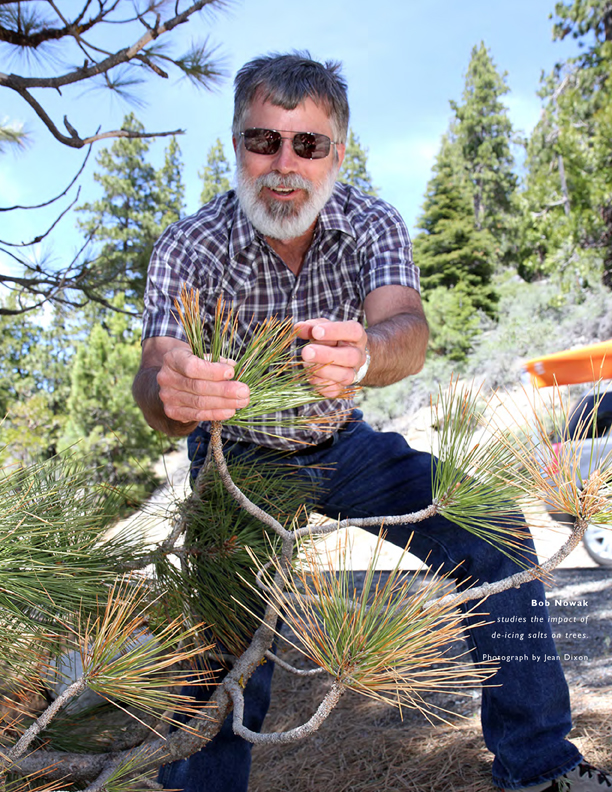
Bob Nowak studies the impact of de-icing salts on trees. Photograph by Jean Dixon.
Bob Nowak’s beginnings as a self-proclaimed “suburban boy” from Chicago, Ill., never deterred him from pursuing his passion in plants. The plant physiological ecologist and professor in University of Nevada, Reno’s Natural Resources and Environmental Science department has studied plants’ survival mechanisms in such varying environments as the Mojave Desert and the Great Basin. When the Nevada Department of Transportation approached him with a project on examining the effects of road salts on trees, Nowak jumped at the opportunity to work in the Lake Tahoe Basin.
“One of the reasons I wanted to work up at the Lake was that I’ve worked in the hottest, driest to the wettest, coldest parts of the state,” Nowak said. “It’s really fascinating to see the variations of how plants function in their environments, with such a large gradient of hot and dry to cool and wet.”
Funded by the Nevada Department of Transportation and the California Department of Transportation, Nowak was tasked with following up on previous studies on the effects of de-icing salts on trees adjacent to main roads. The results of the surveys, the most recent of which was completed in 1990, influenced the two transportation departments’ management of the roads in the winter, said Nowak.
“The two state departments had done a lot of work in improving how they apply and manage de-icing salts,” Nowak said. “They wanted to know if all the changes made a difference, if the impacts of the de-icing salts had reduced over the past 15 years.”
Nowak, with the aid of two research assistants, Kim Camilli and Chandalin Bennett and a postdoctoral researcher, Isabel Munch, expanded the parameters of the original studies. They added control plots away from the road, which they found contained 12 percent more completely healthy trees than roadside plots. In addition to studying salt damage, they measured damage caused by insects and diseases to determine if they were compounding factors to salt damage.
“A concern expressed in the report was that since the study was done in a drought year, the drought, other pathogens and insects may have exacerbated the effects of the salts,” he said.
As Nowak and his team surveyed over 400 plots of land and about 12,000 trees, their data pointed to surprising conclusions. They found that de-icing salts replaced other sources of damage instead of exacerbating them and that salt damaged the trees not as runoff from the roads but through aerial deposition.
“We weren’t seeing any relationships between damage and the salt content in the soil,” Nowak said. “We don’t have any conclusive evidence but a lot of our data suggest that it’s more aerial deposition. As you drive over the road surface, you kick the water and salt up into the air and that gets deposited on the needles of the trees.”
Nowak said this evidence coincided with increased salt damage with years of heavy precipitation. With this evidence, one of Nowak’s suggestions for decreasing salt damage begins with the tourists and residents of the area.
“Be green, slow down,” he said. “You should be driving slower anyway because of safety issues. If people really want to keep the area nice looking, drive slower so you don’t kick up as much of the salt and get it on trees.”
Nowak hopes to fund an upcoming project studying the effects of fuel treatments in the Lake Tahoe Basin. He continues to study plants in the diverse environments of Nevada. It’s difficult to say if his passion for his research will ever wane.
“One thing I’ve always liked about this job is that it has always been interesting, always exciting,” Nowak said. “I haven’t gotten bored yet after 20 odd years on the job.”
 Guia Marie Del Prado