
Determining which source, human or natural, most contributes to particles in the lake.
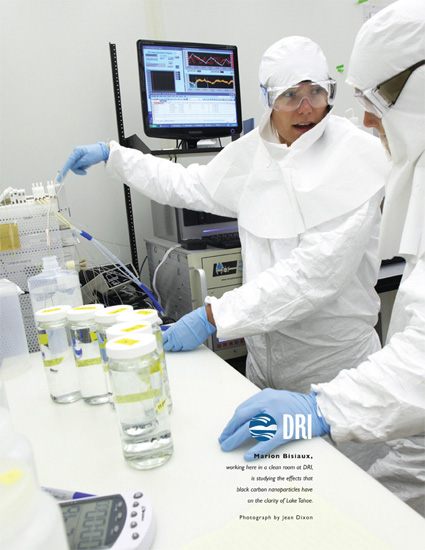
Photograph by Jean Dixon
Marion Bisiaux, University of Nevada, Reno Ph.D. student and graduate research assistant at DRI, first saw Lake Tahoe in January 2008. Bisiaux had just arrived in Reno from her native country of France five days before and was skiing at Mt. Rose Ski Resort.
“It was really pretty because the snow was on the shore,” Bisiaux said. “We hiked down to the lake and these big rocks with rounded shapes were really original.”
She wasn’t attending the University then but was working with Paul Verburg at DRI. Soon after, Bisiaux began working with her current adviser Ross Edwards on ice cores and eventually began her pursuit of a doctoral degree.
“My specialty is the ultra-trace analysis of black carbon” she said. “It is a type of nanoparticle produced by fire and fossil fuel combustion. It has two sides, the natural and anthropogenic side.”
While Bisiaux is still working on the history of black carbon from ice-cores, she also began working on examining the effects of black carbon on Lake Tahoe water quality, since black carbon absorbs light it may affect water clarity.
“For the first time we have the ability to measure black carbon in Lake Tahoe to determine its importance for water clarity issues and ultimately whether we can reduce its input” she said.
Bisiaux said certain toxic organic compounds are often absorbed onto the black carbon in the water further polluting the lake. Bisiaux and DRI researchers collaborating on the project—including Ross Edwards, Alan Heyvaert and Jim Thomas—collect samples from the lake. Once the samples are collected, they are analyzed using an instrument called a Single Particle Soot Photometer in a clean room with a minimum amount of particles to prevent contamination.
“The particles are heated by a laser and incandesce, emitting light proportional to their mass,” Bisiaux said. “The incandescence is specific to black carbon and allows us to determine its concentration in the water.”
Apart from determining if black carbon does affect Lake Tahoe’s water clarity, Bisiaux and others working on the project also want to establish which source, human or natural, most contributes to the particles in the lake.
Bisiaux said they plan to publish the conclusions of their work in the Proceedings of the National Academy of Sciences and Environmental Science and Technology. In the meantime, Bisiaux is completing her doctoral work in hydrogeology and expects to complete her education in 2011.
Though she enjoys Reno and the surrounding area, Bisiaux said she hopes to eventually apply the findings from her Tahoe research to similar lakes in the French Alps.
“We hike, we climb, we ski, we bike,” Bisiaux said of herself and her boyfriend. “Reno is a really nice place for that. But I’d like to go back home or other places. I think it’s good for young researchers to move and see what’s going on somewhere else.”
 Guia Marie Del Prado