
Survey researcher finds the best educational approach at Tahoe is personal
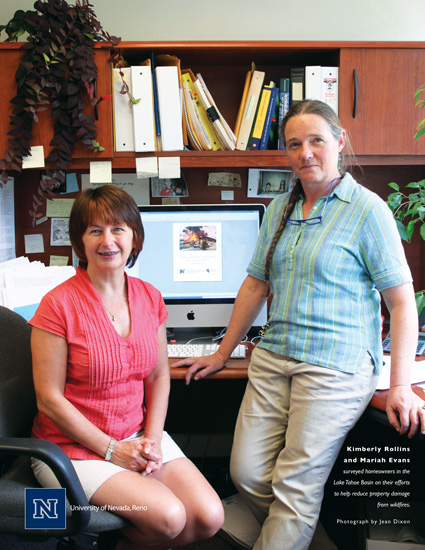
Kimberly Rollins and Mariah Evans surveyed homeowners in the Lake Tahoe Basin on their efforts to help reduce property damage from wildfires. Photo by Jean Dixon
Kimberly Rollins, associate professor, and Mariah Evans, associate professor and sociologist in the Resource Economics Department at the University of Nevada, Reno, are collaborating to conduct research that involves surveying homeowners in the Lake Tahoe Basin in an effort to better understand factors that affect homeowners’ decisions to do their part in reducing property damage from wildfires.
The research will be an expansion of a pilot survey conducted in 2006 in which 19 of the state’s most fire prone communities were targeted. Of the 19 communities, 7 were located in the Lake Tahoe Basin.
Rollins was commissioned to conduct the survey—funded by the U.S. Forest Service—by the University of Nevada Cooperative Extension. The pilot survey was done to see how homeowners in the 19 communities could best be reached and influenced in wildfire threat reduction, such as creating defensible space, a space around a structure that has a landscape that reduces fire danger. The results of the survey showed that homeowners tended to heed the information more if the source was another person they trusted.
“We used the data to analyze the influence of informal community networks,” Rollins said. “Some of the communities showed up as being more likely to take defensible space actions because they were very highly networked. And when asked the most preferred source of information they would tend to trust and use, the result was word of mouth from a trusted source. Not fliers, not DVDs, not the Internet. This implies that a successful and low-cost strategy would be to recruit those individuals in communities who are key links in existing social networks to learn more about defensible space. The rest works through the existing networks.”
With fire being a constant threat in the Lake Tahoe Basin, Rollins hopes to hone in on all the communities in Lake Tahoe in order to get a broader look at homeowner opinions on policy, wildfire prevention, and how their beliefs about who is responsible for reducing risks to safety and property damage play into those issues.
“We would like to expand it to the entire Lake Tahoe area and not just limit it to Nevada,” she said. “I would like to see a range of communities. Some that are clearly at lower risk, some that are clearly at higher risk, so we can drive statistical models to see how people perceive risk, what it would take to induce people to do certain things and what the sum of those costs are, when would they need to be done and what the payoff is.”
The survey plays right into Rollins’ research interests. Though Rollins said she understands that the Lake Tahoe Basin is a resource worth protecting, her questions about how people interact, affect and are affected by their environment is what really drives her.
“It’s a unique little laboratory if you think about it,” she said. “But what I really enjoy is trying to determine the deviations between private incentives and what’s in the society’s best interest so we can design policies and mechanisms.”
But that doesn’t take away from her love of the Sierra and Lake Tahoe as part of that larger environment.
“I love the mountain environment and the Sierra Nevada,” Rollins said. “Lake Tahoe is one part of the region. It’s all together for me. But without the lake, it wouldn’t be the same.”
Kimberly Rollins Profile in the original Tahoe Summit Report
 Guia Marie Del Prado